
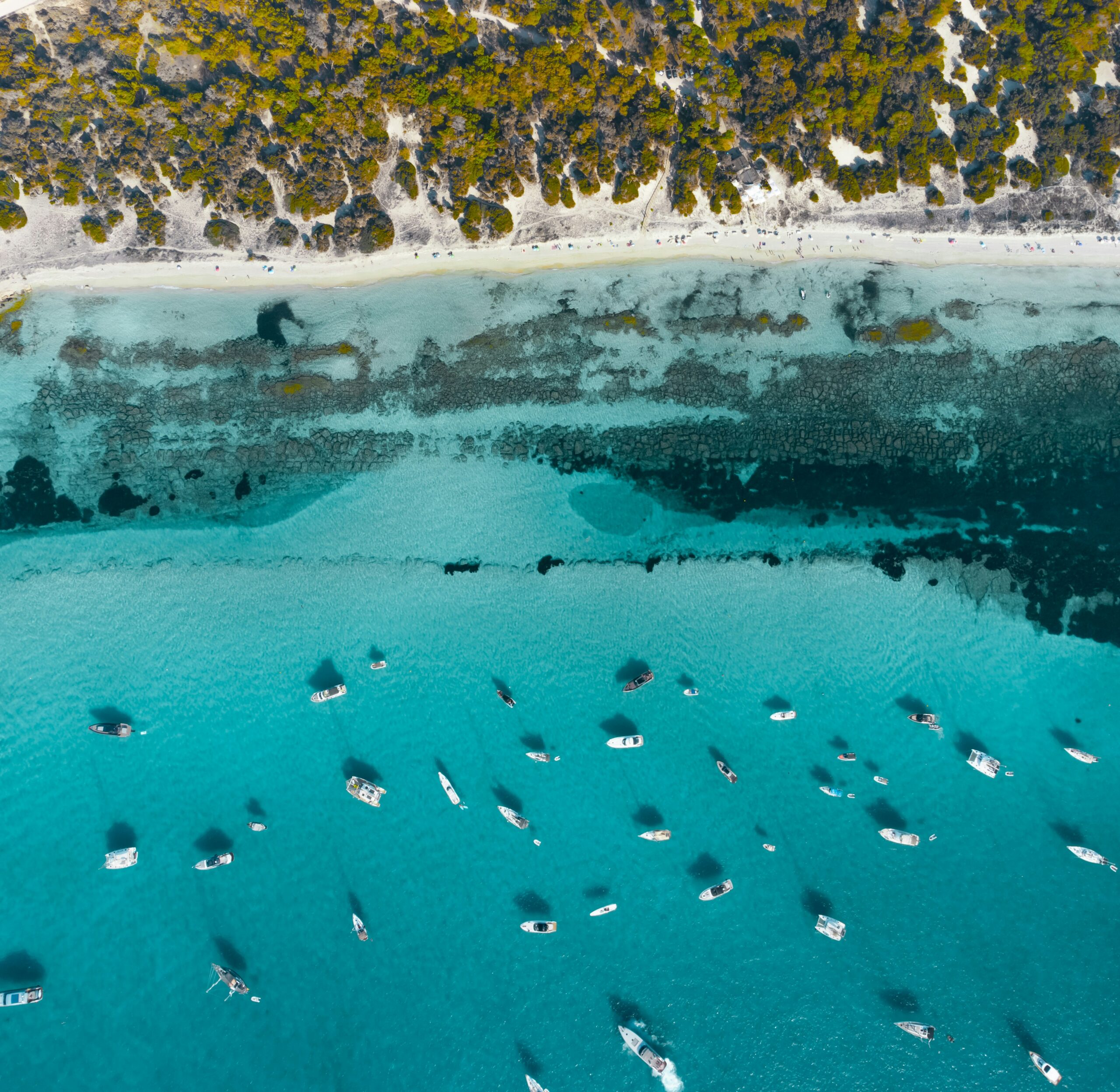
There is a stretch of water between Ibiza and Formentera that stops people mid-sentence. You are on a boat, the island is getting closer, and suddenly the sea underneath you shifts from deep blue to a shade of turquoise that does not look real. It looks like someone has placed the Caribbean in the middle of the Mediterranean and forgotten to tell anyone.
Formentera is the smallest of the Balearic Islands and the hardest to reach. There is no airport. The only way in is by ferry from Ibiza — or, better, by private yacht. That difficulty is precisely what has kept it the way it is: quiet, unhurried, and genuinely beautiful in a way that very few places in Europe still manage to be.
Why Formentera Is Best Reached by Yacht
The ferry from Ibiza takes between 30 minutes and an hour, depending on the service. It deposits you at the port of La Savina alongside several hundred other passengers, all heading in the same direction. You then need transport to reach the beaches — most people rent a bicycle or scooter — and by the time you arrive, the best spots are already filling up.
Arriving by private yacht is a completely different experience. You cross the channel at your own pace, anchor directly off the beach you want, and step into the water from the boat. No port, no queue, no transport. Just the sea and the sand.
The anchorages around Formentera are also, frankly, some of the best in the Mediterranean. The seabed is shallow and sandy for hundreds of metres offshore, which means the water stays that extraordinary turquoise colour even in relatively deep anchorages. Anchoring off Ses Illetes on a calm morning, with the sandbar stretching away to the north and the water visible to the bottom ten metres below, is one of those experiences that tends to become the measure against which everything else is judged.
The Best Anchorages in Formentera
Ses Illetes
The most famous anchorage in Formentera, and the most justifiably so. Ses Illetes is a long, narrow sandbar on the northern tip of the island, and the water on both sides of it is extraordinary — shallow, perfectly clear, and a shade of turquoise that genuinely has no comparison in European waters.
In high season it gets busy with day boats and ferries, but arriving early — before 9am — and staying after the day crowds leave in the afternoon gives you the best of it. In September and October it is quiet enough to feel almost private.
Best for: Swimming, snorkelling, anchoring in shallow turquoise water.
Depth: 2–6 metres. Sand bottom, excellent holding.
Espalmador
A small uninhabited island just north of Formentera, separated from the main island by a narrow channel. The anchorage on the western side of Espalmador is one of the most sheltered in the area, and the beach is long, white, and almost entirely deserted outside peak season.
The mud flats on the south side of the island are famous locally for their supposed therapeutic properties — people cover themselves in the grey mud and bake in the sun. Whether or not the health claims hold up, it makes for an entertaining afternoon.
Best for: Shelter, seclusion, a quieter alternative to Ses Illetes.
Depth: 3–8 metres.
Cala Saona
On the west coast of Formentera, Cala Saona is a small, perfectly formed cove backed by red cliffs and pine trees. It faces southwest, which makes it ideal for catching the afternoon sun and, in summer, one of the better sunset spots on the island. The water is clear and calm, protected from the prevailing winds, and deep enough to anchor comfortably close to shore.
Best for: Sunsets, afternoon swimming, shelter from the north.
Depth: 4–10 metres.
Es Pujols and the Eastern Anchorages
The east coast of Formentera offers a different character — longer stretches of beach, shallower water, and a more relaxed pace. Es Pujols is the main tourist village on the island and has good holding for anchoring, with the option of going ashore for lunch at one of the beachfront restaurants. Further east, the Estany des Peix — a shallow lagoon connected to the sea — is a peaceful spot for a late-afternoon swim.
The Crossing from Ibiza to Formentera
The channel between Ibiza and Formentera — known as Es Freus — is about 7 kilometres wide at its narrowest point. The crossing takes roughly 45 minutes to an hour in calm conditions, and the route passes through a protected marine reserve with extraordinary water clarity.
Es Freus can develop a short, uncomfortable chop when the wind is against the current, so timing the crossing matters. Leaving Ibiza in the morning, when conditions are typically calmer, and returning in the late afternoon when the sea breeze has moderated, is the standard approach.
For a day charter from Ibiza to Formentera, expect to spend roughly 6 to 8 hours on the water — enough time for the crossing in both directions and a full afternoon anchored off Ses Illetes or Cala Saona.
When to Visit Formentera by Yacht
May and June
The water is clear and the anchorages are quiet. Ses Illetes in June, with almost no other boats around, is a completely different experience from the same spot in August. Water temperatures reach 20–22°C by the end of May — cool but perfectly swimmable, especially in the shallows where the sun heats the water from below.
July and August
Peak season. The water is warm (24–26°C) and the days are long. Ses Illetes and Espalmador attract significant boat traffic, but the sheer size of the anchorages means there is usually room — particularly if you arrive early. A local crew who knows the quieter alternatives makes a real difference in high season.
September and October
The best time to visit, in our view. The crowds thin out significantly after mid-September, but the water temperature barely drops — often still 24°C well into October. The anchorages feel private again, the island returns to its natural rhythm, and the light in early autumn is extraordinary. This is Formentera at its best.
Practical Information
Can we go from Mallorca to Formentera in a day? The passage from Palma to Formentera is approximately 80 nautical miles — too far for a comfortable day trip. A multi-day charter that combines Mallorca, Ibiza, and Formentera is the right format for this route.
Is Formentera included in a standard Ibiza charter? Yes. A day trip from Ibiza to Formentera — crossing to Ses Illetes, spending the afternoon at anchor, and returning to Ibiza in the evening — is one of the most popular charters we offer.
Is the water really as clear as people say? Yes. The Posidonia oceanica seagrass that covers the seabed around Formentera acts as a natural filter and is the reason for the extraordinary clarity. In the right conditions, you can see the anchor on the bottom in 15 metres of water.
What should we bring? Sun protection, a towel, light clothing, and comfortable shoes for going ashore. We provide snorkelling equipment on board — and Formentera is one of the best snorkelling destinations in the Balearics.
Book a Formentera Charter with BlauYachts
BlauYachts offers private yacht charters to Formentera from Ibiza, as well as multi-day voyages across the Balearic Islands. Whether you want a single day at anchor off Ses Illetes or a longer journey that combines several islands, we will put together the right experience for you.